False info from a source, and how we dealt with it

As it turns out, my source for a story that ran in Tuesday’s paper — the Ohio EPA — gave me incorrect information.

To compensate, we’re correcting the original story on the web (although it looks like the sub-headline hasn’t been changed) and we’re running a second story in the same place, 1A downpage, that clarifies the facts.

Here’s the link to that story.

Like This American Life recently, the key concepts of my story remain essentially the same. But unlike Ira Glass, we didn’t beat our chests and ask for forgiveness.

I think my editors did the right thing. Daisey’s story could have been corroborated by scores of possible sources. Ohio EPA is the ONLY source for information here, aside from the corporate polluter itself. If we can’t trust the state EPA, who can we trust?

Normally, people at the agency are right on the money. I’ve probably spoken with them on 15 stories, relaying hundreds or thousands of facts, and this is the first one someone’s had an issue with.

But in this business, even a single fact gone awry is a big deal.

That’s why, in the coming days, we may write another story detailing what parts of the process failed, why, and how a few experts would fix them.


Credit unions vs. banks: the fight started late last year; here we catch up with the data

New credit union data provided an occasion to discuss, with an A1 story, the differences between the two forms of banking — and the PR war that’s been fought since the Occupy movement started pushing credit unions last fall.

I also reported that the ubiquitous local bank, Security National, took a $100 million TARP bailout to compensate for losing money on sub-prime mortgage securities.

Credit unions are growing in members and deposits faster than they have in the past. While it doesn’t seem to be impacting banks much yet, the potential is there.

So the spokesman for the state association of bankers forwarded me a GAO study. It seems to indicate that banks do a better job serving people “of modest means” than banks do. Which undermines the reason for credit unions’ tax exemption. Are credit unions screwing society on the level of GE? I’m gonna look into this further.

Stories finalist for AP investigative award

My work on the aftermath of the anti-narcotic bill (see the immediately previous post) has been chosen as one of the top three examples of investigative reporting done at newspapers of our size in Ohio.

Three investigative reporting finalists were chosen in each of the five circulation-size categories. That’s among more than 3,000 entries.

The AP Society of Ohio issues the awards, chosen by judges based outside the state. I’m told judges are editors from some of the nation’s best newspapers in each circulation-size category.

The Springfield News-Sun falls in the category for 13,000-24,999 average daily circulation.

Medications still hard to come by for those in pain

Continuing one of my stories last summer, I reported Sunday that people are still having a hard time finding doctors to treat chronic pain. And doctors are still wondering what’s legal.

It’s safe to say nearly all doctors in the Miami Valley have stopped prescribing strong pain medication for fear of showing up on the radar of some Attorney General investigation.

A lot of patients and — as judging by a doctors’ conference Sunday afternoon, a lot of docs — are angry about the lack of clarity in how the law’s enforced. Ohio is at the epicenter of a national crisis of painkiller availability brought on by a heavy-handed war on the drugs’ abuse. While I broke the news last summer, Radley Balko, a national human rights reporter, is currently reporting a series on the problem. Find the first two articles here and here.

Mind you, we’re talking about a totally legitimate need for medication. These people have full documentation of some horrendous injury and, in most cases, have tried physical therapy and/or non-pill pain interventions. In other words, they’re taking a proper dose for documented symptoms and they’re not selling the stuff.

I saw the first minutes of an innocent man’s freedom after 20 years in prison

Roger Dean Gillispie leaves a bus with supporters to face his parents’ home, which he hadn’t seen in 20 years. According to a U.S. district court decision six days ago, Gillispie was wrongly convicted of nine counts of rape in 1988. Photo by Teesha McClam, used courtesy of Dayton Daily News.

Though he likely could have gotten out sooner by feigning guilt, Gillispie maintained his innocence throughout his imprisonment. This persistence would seem to make him an even more valuable advocate for The Innocence Project — in Ohio, an arm of the University of Cincinnati law school — which helped free him.

My co-byline appears on Dayton Daily News‘ front page today, above the fold. Here’s the PDF.

An Ohio attorney-turned-politician, Jim Petro, has been behind Gillispie for several years. Petro’s book on wrongful convictions has been making waves in the world of law enforcement and is dedicated to Gillispie.

After the jump I’ve pasted my notes from the initial meeting in the bowling alley. (Edited for space, the article above leaves out the small details of Gillispie’s first minutes of freedom.)

Continue reading

Coverage of anti-fracking group

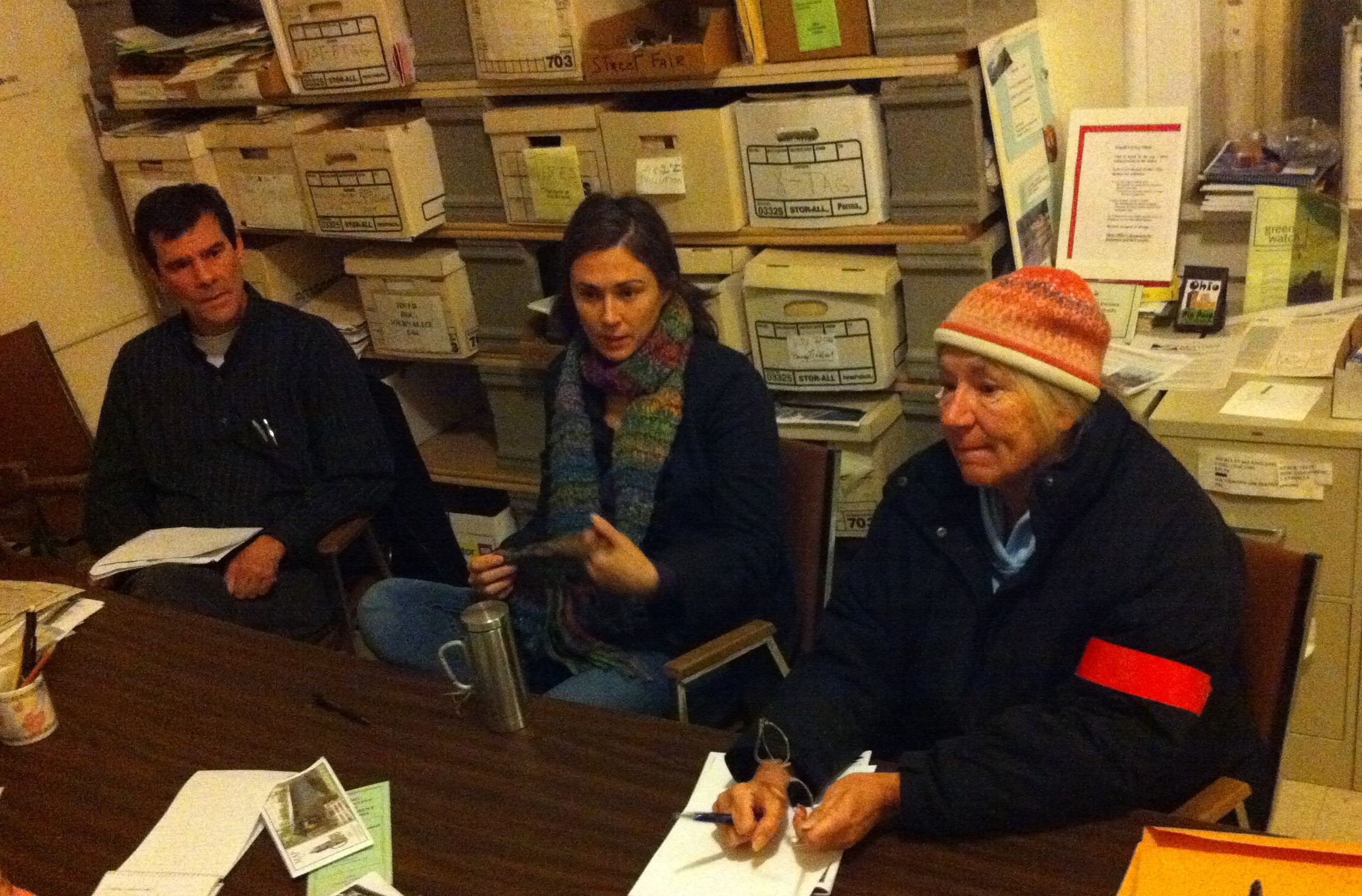
Three members of an anti-fracking group based in Yellow Springs have traveled around the state and the country to teach others about the possible dangers of fracking and to join protests against it. Photo by Brandon Smith-Hebson, used courtesy of Dayton Daily News.

To accompany a Sunday front-page centerpiece on fracking, once again I joined the Dayton Daily News staff to report the fracking opposition emanating from Yellow Springs.

It was hard to be super specific about these people’s concerns in such a brief story (after all, they’re true scholars of natural gas drilling). But I think I communicated the the essence of their angst. Here’s a PDF of the same. My piece appeared on page 11 of the “A” section.