A map to creating fewer veterans while respecting those we have

I’m one of three newer members of the Hartford selectboard. I’m going to explain why I probably won’t vote against posting a dozen or more banners featuring veterans on poles in downtown White River Junction for six months out of the year.

It’s my first elected position after a lifetime of following politicians, and holding them accountable, through writing. Mostly getting paid with just “sandwich money,” as my girlfriend likes to say. While I probably* didn’t risk my life for a cause, the pay wasn’t much different from that given to members of our armed services right now. They’re getting so little, especially considering they put their lives on the line.

And we never have paid them much. My best friend from high school was deployed to Iraq. He and I were the only protesters at the George W. Bush rally in Chillicothe, Ohio. (Technically we were protesting the Patriot Act, which eroded civil liberties.) My buddy came back a changed man. I think that, like my uncle who came back from Vietnam, my friend would say it wasn’t worth the money. It was, however, worth learning how devoted you can be to a cause, and how deeply you’re able to bond with fellow humans.

It must, and should, be said that these things can be had outside the military. Those two veterans and I have shared a viewpoint: Support all veterans. Oppose all wars.

Opposing all wars necessarily means opposing the bureaucratic, and wildly profitable, human machine that nudges us into those wars. (It must be said that some part of that “machine” is public messaging in small towns like ours.) In a post a couple weeks back to social media and my personal website, I quoted Dwight Eisenhower on how “Every gun that is made, every warship launched, every rocket fired signifies, in the final sense, a theft from those who hunger and are not fed, those who are cold and are not clothed. This world in arms is not spending money alone. It is spending the sweat of its laborers, the genius of its scientists, the hopes of its children.”

Other wealthy countries have tax rates around 40%. With these taxes, they provide education, healthcare, child care. In the U.S., we pay for most of these services privately, out of our own pockets. Though we aren’t being taxed by the government for them, we are still paying for them. Some studies show that these services combined now cost average American families around 70% of our paychecks. So much for “low taxes.”

Instead, much of our tax money goes to the military. Around 50% of U.S. federal tax revenues—this year and every—go toward warmaking. Possibly more. (Receipts provided at the post on my website.) Many well-reported articles, including a bombshell in Rolling Stone in 2019, show what audits show: record-keeping at DOD is a farce. They can, and likely do, spend whatever they want. As Eisenhower said, each of those dollars is just wasted effort that can no longer be put to use for us.

The value we get out of the war machine isn’t what you might think. China, the next-largest spender, pays for one tenth what we do. Even if we spent only what China spends, we’d almost certainly face no challengers, given our network of allies. For its part, China hasn’t bombed anyone in 80 years. In that time, we’ve bombed 28 countries. If you’re curious about the devastation we’ve wrought, read “The Jakarta Method.”

Perhaps you think the question is only whether I support veterans, not whether anyone supports or opposes warmaking generally. And yet. Huge swaths of veterans say that to support service members and veterans, you *must* oppose all wars.

I say let’s not “support” veterans in the half-measure way we support pregnant women: all our effort going into persuasive efforts, into message-making, and comparatively little effort going into caring for women or their babies. This is how I see these banners: all smoke and no fire. I would much rather we offer better services to veterans, and better opportunities to connect in the community.

A couple weeks back, when I voiced my opposition, I sent a letter to the group that proposed the banners. Rather than six months, I recommended, perhaps we fly them a few days around each of the two veteran-focused holidays. I also stated a couple other conditions for my full-throated support: a design review by some panel of long-time downtown stakeholders; and the ability for an anti-war veterans group, Veterans For Peace, to design about 1/5 of the total banners. I didn’t receive a response from the group.

Perhaps the free speech I’m using to say these things was won for me by service members. But not *necessarily* so. It’s not self evident. Lots of countries have free speech beyond ours (as rated by organizations who study this kind of thing), and they’ve had wildly varied military histories. Several of them have no militaries at all. Others had ground invasions, defended themselves, and then disbanded most of their military, as George Washington had hoped we would do here.

When it comes to brass tacks, how I vote will have more of a personal motivation. It’s about my conscience. If there’s any chance that even one more kid could sign up due to how I vote, then I must decline. And you can’t deny there’s a chance.

As I said, I’m new to official public service. I don’t represent the board; I represent myself. I’m trying to remain true to myself. (Would you have me be any other way?) For what it’s worth, I do represent a contingent of Hartford residents who share my beliefs. About half the letters I received in response thanked me. The letters were nice. None had a hint of disrespecting veterans. On the contrary: we’re doing what we think will help create fewer veterans. That’s something my vet friends can get behind.

Epilogue: A lot of mass media in recent years has been happy to point out how we’re all so very different. As a former investigative reporter, I can’t help but ask: who benefits from that? From us being so quick to dismiss one another; to assume things about one another? I know one thing: if we were united against military spending, then they couldn’t spend what they do. And we will never be united against military spending if we can’t talk openly and honestly about how to do precisely this: show vets we respect their personal sacrifices without any promotion of America’s way of war.

Brandon Smith is a member of the Hartford Selectboard but writes as a private citizen. His writing has been published in The Guardian, Al Jazeera, The Daily Beast, and Chicago Reader. Smith has won an investigative reporting award from the Associated Press, and was the youngest-ever winner of the I.F. Stone award, the only U.S. award for independent journalism. He now works for a house builder in the Upper Valley.
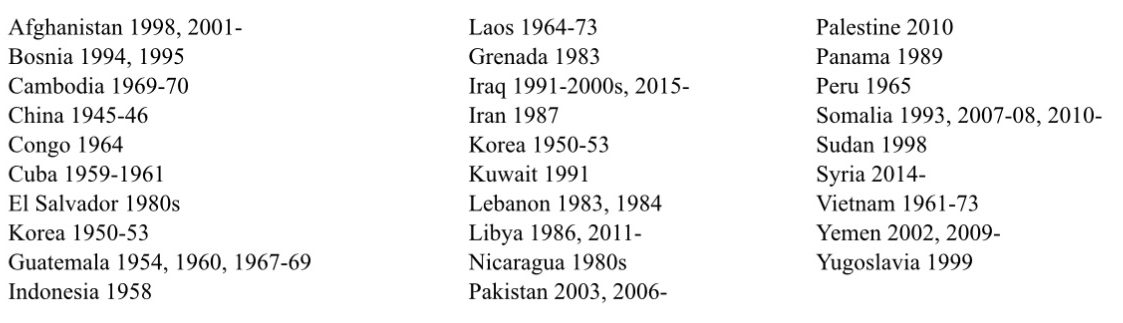
How I think about the U.S. military

All the countries the U.S. has bombed since WWII. The list represents the nations of approximately 1/3 of the humans on earth. The next largest military spender, China, spends 1/10 what we spend and has bombed no other nations since WWII.

A preface:

When I was a high schooler, the History Channel flew myself, our history teacher, and a couple other classmates to DC. They interviewed us for our work at the cemetery near us. We had discovered documents in county archives that indicated there was a part of this cemetery where Civil War veterans of color were buried. They had been segregated into their own regiment of sorts: the “U.S. Colored Troops,” or USCT. Unfortunately they had not been given headstones, so we didn’t know where their bodies were. We used ground-penetrating radar to locate them, and we applied to the VA to get them headstones. (As you may know, if a veteran cannot afford a headstone, then one will be provided to them.) Then we installed the headstones at their gravesites. The VA Secretary at the time brought us to his office and gave us nice letters of thanks. But we had done the work for those soldiers. And now more people would know about their sacrifices.

I wanted you to know that before I say what I’ll say here.

We have a vote Tuesday, on the Hartford Selectboard, to weigh in on placing banners honoring local veterans on poles in downtown White River Junction. I’d like to explain my position on that, which cannot be separated from my larger views on the blood and treasure we devote to the military. (I’ll discuss those too.)

I would prefer to not help local military recruiters, if at all possible. This awful economy, and especially the paucity of services and safety nets compared to other developed nations, does the recruiters’ work for them.

My belief is simple: “support troops and veterans, but oppose all wars,” a belief many—if not most—vets and active duty service personnel share.

I think these banners would give the idea, to the more impressionable of young folks, that serving in the military is the most, or at least one of the most, honorable life paths. We don’t seem to honor any other life path with banners downtown. I don’t fault folks for signing up for the service, and I’m sure it takes lots of courage and skill. But I’ve talked with a heck of a lot of veterans who say that, once they were in, they learned how pointless (or simply empire-bolstering, take your pick) our military actions have been. Many other vets say that, if they had been able to access the social services every other developed nation provides by virtue of paying taxes—particularly healthcare and education—then they wouldn’t have joined up.

If it’s looking like we’re heading toward approving these banners (again, I do heartily support veterans), I would advocate for every other banner to be from an organization that opposes all wars, such as War Resisters League or Veterans for Peace. Poll all local veterans; I bet a majority would support this.

I’m a huge fan of—Republican war hero!—Dwight Eisenhower’s views of our warmaking apparatus once he became president. I think you’ll be surprised to hear what he said. It’s even more true today than it was then.

Every gun that is made, every warship launched, every rocket fired signifies, in the final sense, a theft from those who hunger and are not fed, those who are cold and are not clothed. This world in arms is not spending money alone. It is spending the sweat of its laborers, the genius of its scientists, the hopes of its children.

The cost of one modern heavy bomber is this: a modern brick school in more than 30 cities. It is two electric power plants, each serving a town of 60,000 population. It is two fine, fully equipped hospitals. It is some 50 miles of concrete highway. We pay for a single fighter plane with a half million bushels of wheat. We pay for a single destroyer with new homes that could have housed more than 8,000 people.

This, I repeat, is the best way of life to be found on the road the world has been taking. This is not a way of life at all, in any true sense. Under the cloud of threatening war, it is humanity hanging from a cross of iron.

I fear that it’s impossible to have a president today who would speak this. Our current system of funding federal elections, which requires giant checks from giant businesses like defense contractors, all but ensures nothing like this could be said by a mainline candidate, ever again.

As you might be able to tell, I am fairly passionate about military spending—that is, cutting it. To say nothing of the moral issues of death & destruction, and meddling in other nations’ affairs, it’s just such a waste. Eisenhower said it more eloquently, but here’s an adjacent thought: put a dollar into education, or into a business startup loan program, and that dollar makes 5, 50, or 500 dollars of “dividends” for our society. Put a dollar into a bomb and it yields $0 of future value for us. It has the same effect as setting our cash ablaze. And frankly, if we did that, the world would be better off.

Easily 50% of our taxes goes to war and warmaking. Some say realistically it’s more. Back when the Pentagon budget was $470B, we were spending nearly double that (~$1T) on warmaking, annually, because the DOD budget doesn’t include all kinds of other expenses the war juggernaut requires:

  • interest on debt due to “defense”
  • the VA
  • the nukes program (it’s in DOE)
  • the actual wars being fought at any given time (most folks don’t know that doesn’t come from the DOD budget)
  • the warmaking parts of the CIA
  • the war-prosecuting parts of the FBI… and on and on.

With the DOD budget in 2024 now at $840B, and the bulleted items likely costing as much or more, that’s nearing half of our ~$4.9T tax revenues.

Oh, and the military has never once passed an audit. See this 2019 article about the clown show that is trying to audit the military, and know that we haven’t passed an audit since then, either.

In one of the many failed audits in recent years, the margin of error was something like 20x the budget of the Army. In another, the margin of error was several times the U.S. GDP. In other words, audits of so-called defense in this country are a farce; those who run this machine laugh in the faces of those who would try to hold them accountable. And remember, they *can* spend roughly infinite money, since money comes into existence when the government writes a check. So all the hemming and hawing about the DOD budget means—as my grandma would say—diddily squat.

“But we have to defend ourselves!” you might say. Well, even our official military budget is 10x the next largest spender in the world, China. So if we only spent as much as them, chances are we’d still be fine because we have a mutual defense pact with so many other countries. For it’s part, China hasn’t bombed or invaded *any* other country since WWII. It has military bases in *no* other countries. Since WWII, the U.S. has bombed countries that collectively contain 1/3 of the people on the earth (see the list at top of this post), and we currently have military bases in about 90 other countries.

Perhaps attempting to reduce military spending is the “conservative” position, in the old definition of that word. Prudent. Thinking of long-term benefit rather than short-term goals. What has happened to this country’s conservatives? Now, the word “conservative” tends to mean you want to strip-mine every resource, natural and human, for the most profit as quickly as you can get it. In other words, the opposite of its original definition. This makes me think of the government from George Orwell’s fictional dystopia, which has convinced the public of its slogan: “War is peace. Freedom is slavery. Ignorance is strength.”

C’mon, folks. Words have meaning. And that meaning matters.

So no, I’m not keen on flying banners implying that it’s among the most honorable of paths to choose death, or risk of death, for the system I describe above. The path is courageous for sure. But alas, we don’t know whether the lost souls whose photos would blow in the wind, and who may have otherwise been our neighbors, would choose the path again. Especially if they understood what I’ve outlined today. For all we know, they might have vehemently opposed using their image in this way. (If they’re your relatives, sure, you may know. At least until the point at which they last communicated, openly and honestly, with the outside world.) I think the best data is from vets who’ve returned—and they’re generally pretty salty about it all, if not outright war protesters now.

Speaking of the prescience of fiction: I’ll paraphrase a social media post by user @austerrewyatt1: We all root for “the resistance” to empire when it’s portrayed in Star Wars, The Hunger Games, The Matrix, V for Vendetta. When it’s fiction we understand. But so many of us refuse to see it when it’s the reality we’re living in.

Kids and families in Hartford

I think families aren’t coming, or happening once people of child-bearing age are here, because of this:

https://livingwage.mit.edu/counties/50027

An actual living wage to have one child here is $38.08/hour with two parents and one working, or $41.73 with one parent in the household. That’s annual salaries of $79,206 and $86,798 respectively.

The Census’ American Community Survey has 13% of Hartford households making 75-100K; 16.5% making 100-150K; 8% making 150-200K, And 7% making >200K. I think we should focus on allowing folks to have a kid singly, but perhaps we be more fair to employers (never thought I’d say that) and split the difference between single and partnered parenthood. That’s a cool $83K. Since this distribution appears to be a bell curve, even though 83K isn’t halfway up the block of income data it’s in, the lower half of the block likely contains half the population in the block, so if we remove 7% we’ll have a roughly accurate % of population under our $83K.

This means (6.5+16.5+8+7) 38% of households in Hartford make enough money to be said to have a “living wage with one kid.” 62% of households here are unable to have a family without extreme hardship. I spent most of my working life hovering right around the living wage marker for my location, or just under it. (Living wage for NO kids.) This existence is hard. It’s a real marker, which should be trusted.

Since a good portion of the households we’re discussing (basically, those who would have a kid if they felt they could) are 2-person households, average household size in the group is definitely something above 1. And it can’t even have one offspring without extreme hardship. That means we don’t have an economy in Hartford whose participants—we’re all forced into participating, aren’t we?—can increase the population. At least without poverty, or de facto poverty.

So 38% of Hartford can afford to have a kid without extreme hardship. According to the 2021 American Community Survey, 23.5% of Hartford households have children living in them.

As we know, some folks choose poverty for the chance at having a kid. And “more power to ‘em.” But my takeaways—for me, not for you necessarily—are: 1. don’t ask why this society isn’t having kids. 2. never say this society is irresponsible, because it’s clearly very responsible with money; and 3. if we think families with kids are important, either for diversity of humanity or just the long-term sustainability of an economy… the situation I describe here is what we need to rectify.

A new chapter on the Hartford Selectboard

Hi, all! I won the election! It’s a small town I live in, but big by Vermont standards, and I’m so proud to live here.

I’ll keep posting my thoughts here. Perhaps I’ll also copy them to the Listserv. What a wonderful tool, the Listserv. (If you’re not on it, sign up at the website of Vital Communities.) I wish my town had had one growing up. Imagine being able to tell basically everyone in your town something you think is important, or advertise your event. It’s an amazing tool for connectedness.

My platform for Hartford Selectboard

If you live in Hartford like I do, perhaps you’d like to know specifics about what I’d try to do with a seat on the town board. I’ve prepared this bullet-point document for those extra-curious folks. Please reach out with any comments or questions, to hey -at- brandonsmith -dot- com.

HOUSING

  • The price of housing is too high here. It’s my number one issue. We’re both forcing out older folks and we’re prohibiting younger folks from coming. One way to address this is to address supply. I work for a house-building company, and I have all kinds of ideas for this, from helping carpentry/building companies establish panel production shops so they can increase the speed and cost-efficiency at which they can build, to working with big supply houses like Bethel Mills and LaValley to establish a line of basic building products, on which they accept a slightly smaller margin to help assist this crisis. But we must talk about the elephant in the room: prices have skyrocketed in large part because in the last 10-20 years, giant corporations have started buying homes and apartments. Families didn’t used to have to compete with companies with billion-dollar valuations; and we shouldn’t have to. I want to figure out how we as a community ban companies from buying single family housing here. Or if we can’t ban them, then create barriers to their entry that, as businesses, they won’t cross because they’re so high they know they won’t make money.
  • Define “Hartford affordable” monthly rent as: whatever the minimum wage here is, times 2080 (hours in a full-time work year) divided by 12 (to convert to months), times .75 (roughly what we take home after deductions), times .33. This calculates ⅓ of the monthly takehome of someone on minimum wage. Use current powers of the town to incentivize charging affordable rates, and to disincentivize unaffordable rates (say, for any entity that has 3 or more unaffordable units, to protect retirees who rent a couple units.)

WAGES AND WORKER CONDITIONS

  • Set minimum wage at $23, to move up $1 a year for the next two years, because effectively the state has abdicated its own role in setting minimum wage. (If you can get a job at Dunkin or any big box store for $19/hour, then a state minimum of $13 effectively means nothing.) Yes, I recognize that according to state law, towns in Vermont cannot set their own minimum wages. But I believe we have an argument to do so because the state has abdicated its own responsibility in this arena. They shouldn’t be able to defend an abdication. If we can find an attorney to represent the town pro bono on this, the scheme won’t use taxpayer money if the state chooses to sue rather than to update its number to one that means something.
  • I propose we create a kind of marketing program, perhaps with some incentives attached, for when a business pays 100% of its workers the “living wage for a one-earner household with one dependent” according to MIT’s living wage calculator. (Currently $34.03 in Windsor County, about $70K/year pre-tax.) Make these businesses certify that they update wages to match the MIT number for this metric twice a year. Basically they would get some free marketing by the town; a special designation that they’ve made hard choices to do the right thing: 1. give a serious percentage of what workers generate back to those workers, and 2. charge enough to make this happen, which is to say, not subsidize the experience of the customer via the workers. The town could even give these businesses, as an incentive, something like a TIF: promising that its own taxes won’t increase because of this.
  • Vermont mandates that a worker must accrue sick time at a certain rate. Hartford could do the same with general PTO. Start with firms of 7 employees or bigger and mandate accruing 7 days per year. After 2 years of implementation, it would expand to apply to firms 5 employees or bigger and start requiring accrual of 10 PTO days per year. This shall be in addition to the aforementioned VT sick days and any holidays an employer already provides as paid time off. I believe what the rest of the developed world believes: that if a business isn’t charging customers enough for this to be able to happen, then the business is effectively subsidizing the experience for the customer with revenue that should have been provided to the workers.
  • Ensure that at least one town employee is trained on helping workers if they need guidance on filing for union elections at their job, or filing grievances with the National Labor Relations Board. That person should be given the bandwidth to field the enquiries of any resident who needs it; should maintain a small library of contacts where a worker could get in touch with someone in a union in their field; and should have an adequate budget for promotion of their services to all residents of the town.

BENEFITS TO RESIDENTS THAT AN ENTITY LIKE OUR TOWN GOVERNMENT COULD USE ITS HEFT TO IMPLEMENT (OR HELP IMPLEMENT)

  • We could buy medical debt for Hartford residents at pennies on the dollar, and cancel it. Connecticut just did this for huge swaths of its residents, and given how much fewer people we have, there’s no reason we couldn’t, either. This one’s a no-brainer. It would mean more money in locals’ pockets that will likely be spent locally.
  • I’ve heard plans are in the works to seriously update the Bugbee senior center. Those need fast-tracked. It’s not ADA compliant, and several local seniors have been trying to draw attention to this, calling it “a disgrace.” And rightly so, considering all the other things that have been updated in town in the 40 years since this building was updated last.
  • Provide micro grant funding for low-income residents to obtain the services of an organization (there are many) that represents people in appeals to credit rating agencies, to get negative marks removed from credit scores. Especially for life’s necessities like health care or student loans. Better credit scores in Hartford will mean less useless money sent out of the community in interest on debt.
  • Create a heating fuel buyers’ collective at the town level, where any resident can subscribe, and each year the town pre-negotiates, with fuel vendors, rates for each fuel below market rate (hopefully well below). Residents then buy their fuel through this program and save real money.
  • Use the town’s ability to secure low-interest credit. Open up the ability for residents to use this line of credit for specific outlined purposes that pay dividends, so to speak, in people’s lives: heat pumps and/or solar systems for home owners, is an example. Or could be equipment needed for personal industry. Sets of power tools or woodworking equipment for people who would be builders. Gym membership or a piece of home workout equipment. Reliable personal transportation or repair to the same. An emergency health expense that can’t and won’t happen without a line of credit (Where insurance and the provider would deny treatment otherwise.)
  • Heat pumps are such an incredible tool that perhaps they should be the subject of their own program. I would push for a selectboard-mandated goal of providing, via financing with a sliding scale based on income, heat pump heating and a simple mechanical ventilator (like a Lunos) to all residents who don’t already have it. The goal should be to accomplish this in the next 5 years. Cost of install, to each recipient, might be spread over 3 years. Renters can apply and landlords shouldn’t get a veto, because whether or not renters pay for their heat directly, they always pay for it somehow.
  • Speaking of equipment to help people get into the trades: I’m interested in a pilot program, working with employers in the Upper Valley (and especially Hartford), where if a local high schooler goes to college or trade school and relocates here immediately following, they can be guaranteed a position at a pre-arranged, attractive rate of pay. That would also help them determine whether any debt for school is warranted, and whether they’d be able to pay it back.
  • Speaking of libraries, we should engage the community for brainstorming on what other categories of things, beside books, we could add to the existing libraries. They’ve already started this, but we could expand it in earnest. I once ran a small business renting camping gear; that’s one idea. Another is tools, of course. The tool that you use once every year or two, that you’d otherwise rent from Home Depot, could be free at one of the local libraries. In due time we could establish a makerspace, where folks can come and use stationary tools they could never otherwise afford. I imagine we have enough folks willing to donate their equipment to an effort like this. It just takes a shared vision and dedication.

BUILDING COMMUNITY FOR OUR FUTURE

  • Studies show that walkable communities are both healthier for residents and have better local economies, perhaps because people from non-walkable communities around them visit them for the “sense of place.” I’ve made a list below of the diversity of businesses and services that are really necessary, in a one-mile radius (20-minutes walking), for a community to be truly walkable. For all the little alcoves in Hartford that have a good start making this happen, the town should do what it can to fill out the rest of the list. That could mean active solicitation of the public, grants and low-cost small business loans, tax incentives, or other creative avenues to attract them. The list:
    • grocer
    • bank
    • school or schools for grades K-12
    • library
    • family doctor
    • dentist
    • cafe (and bakery if these things are separate)
    • pub
    • bookstore
    • clothing store
    • auto repair shop
    • casual restaurant like a pizza shop
    • venue for a small live music show (like with a small stage) if it’s not covered by other locations here
    • gas station
    • laundromat
    • drugstore or pharmacy
    • post office
    • child care operation(s)
    • hair cuttery
    • hardware store
    • space on the larger side for large social gatherings
    • and non-auto transit to other walkable areas (and in this case, the WRJ Amtrak stop and the Dartmouth Coach).
  • Speaking of promoting walkable communities, walking and bicycling are symbiotic for the ends we’re seeking in walkabikity. So we want protected bike lanes on all arteries of these walkable communities, and protected bike lanes or paths networking each of these communities together. At some point we should consider establishing a rental scheme of electric bikes—whether helping a local small business get set up doing it, or barring that, establishing one as a town. I was an electric bike hater until I tried one. Changed my world.
  • Let’s start down a road of police reform with an important one but one I think everyone can get behind: making it against town ordinance for an officer to lie about certain important things while they’re on duty, or acting in their official capacity. To be clear; the question of whether our officers ever have lied in these ways has no bearing here and is irrelevant; the only question that matters is whether the town allows them to going forward. No federal law, or to my knowledge Vermont state law, prohibits police from lying in the following ways, nor can their cases be dismissed because of it: They can lie about their ability to get a search warrant; can lie and say you will get a lighter sentence if you confess; can lie and claim that your fingerprints or DNA were on the evidence; can lie to you about an accomplice confessing; can lie about being an officer; can lie and say a conversation is off the record when it isn’t; can lie and say that a victim identified you in a photo; and can lie about whether they’ve lied to you previously. So let’s codify into ordinance the respectability, the increased trust from the community, that would come from prohibiting untruthfulness in these important ways.
  • People I’ve spoken with at the Bugbee Center and elsewhere have various concerns about drug use and, separately but sometimes adjacent, unhoused populations. Currently these are real issues in our community: for each of us in one way or another, but especially for the deep, complex, lovable, humans who are experiencing these conditions. I know two things about this: 1. The current systems of our world produce these problems and Hartford’s current systems have not solved them. 2. These two problems have been effectively solved in other places, and the people who implemented those systems elsewhere *do* know how to solve them. What if I told you there are places around the world that have reduced their drug use—similar to ours today—by 97% over 5-6 years? If I told you that other places, with similar unhoused population to ours, have secured housing for those folks to the tune of 75-80%, over an even shorter timespan. If I told you this was possible, would you be willing to set aside what you believe the solutions are, and be open to whatever has actually worked elsewhere? (Part, though likely not all, of the funding could come from what we currently spend to deal with these issues.) I know I would support this in a heartbeat. I’m not fully briefed on what the systems to fix these issues entail, so I shouldn’t say I know what fixes them. You also probably don’t know how Portugal solved its drug problem and Finland solved its problem with houselessness. So like me, you probably shouldn’t claim you know a solution. But I’m curious about learning what it entails, from the people who have done it. I hope you’ll join me in being open to discovering what’s worked, and just doing that, no matter how it intersects with our prior beliefs. These situations are too important to do anything other than what’s been proven to work.

Running for Hartford Selectboard

Hi! I’m Brandon Smith.

You may have found yourself here because you heard I’m running for a seat on the Selectboard for Hartford, Vermont, where I’ve lived since the height of the pandemic. (Presumably you also know Hartford includes its villages: White River Junction, Wilder, Quechee, and West Hartford.) A few paragraphs down details how I would approach a Selectboard seat. But now, a little about me.

At the moment I work as a kind of project manager (“production coordinator”) at a local house-building company, Earthshare Construction. Before this I worked for a couple other New England building companies, and before that, for about 15 years, I did a combination of journalism and cooking in fancy restaurant kitchens—in Chicago and DC.

I’m the youngest-ever winner of the national award for independent journalism, and I still do the occasional reporting project. For a time I worked as a contract researcher for investigative units at Washington Post and ProPublica. In the first months of covid, I helped develop the Post’s methodology for tracking covid deaths more accurately than the heavily-minimized figures that politicians and the CDC were putting out. See more about me here, and examples of my journalistic work here.

Lately I’ve been building a woodworking shop in my garage. I enjoy a good sci-fi show, or a typewriter-typed letter to a friend. Email me any time—to express solidarity or concerns or, heaven forbid, to offer help with this campaign. I’m at hey -at- brandonsmith -dot- com.

How I’d approach a Selectboard seat

(P.S. – sorry about all the ads. I’ve used this site as a “blog” so infrequently over the years that it didn’t make sense to have a paid version of hosting; I’m looking into upgrading 😅)

1. Leveraging local law and policy as a tool to level the playing field for those without wealth.

It’s often said that “the law is a sword only the rich can wield.” Not enough policymakers are committed, as their first priority, to fighting for equal starting lines for all in the race of life. My ~15 years of justice & accountability journalism introduced me to humans of every persuasion, and also the law. (I’ve taught classes and workshops at more than 20 colleges & universities, sometimes on transparency law for attorneys’ continuing education credits.) People for whom owning things is their primary source of income (and I’m not talking about elderly retired folks) have been waging a kind of top-down class war on those who support themselves with their labor. The ownership class’ ability to influence policy has been outsized, due to their ability to fund candidates’ re-election efforts. These phenomena need an equal and opposite reaction, and I intend to help organize and support that. A 2019 Brookings Institution study described the American economy that’s hidden from popular view: 44% of Americans work in “low wage” jobs with median annual pay of $18K. This is a national and local disgrace. Let’s fix it together.

2. Creating a place where decent housing is priced properly for everyone.

We’re no longer cro-magnons; even in ancient times, civilization viewed housing as a human right. So let’s not regress to back before written history, shall we? What does it mean for a government to act on this principle of housing as a human right? I intend to help answer that. My full-time job is coordinating the production of an Upper Valley house builder, Earthshare Construction. I also help lead the local building science meetup group. At my urging, this group is starting a coalition of supply houses, builders, designers, lenders, and government hell-bent on curbing housing pressures. Barring an even more dramatic shift in how we think about housing, a home should cost a person or family no more than the old conservative rule of thumb: 33% of one’s monthly takehome pay. If someone is making $18/hour—which should be a bare minimum wage here, if not more—then that person is taking home about $2500 a month. So housing should be available at $825/month. How many $825 units does Hartford have open currently? How many of these have a second bedroom for a child if that person has one? These questions should be front and center for local, state, and federal policymakers. To the extent they’re not, these policymakers have lost their way.

3. Instituting more direct democracy.

I grew up in a town about the size of Hartford, my first 19 years living in an Ohio town of about 11,000 people. I’m sorry to say that the town council there behaved like so many, and didn’t really prioritize input from the folks they ostensibly served. I want to flip that on its head by seeking the opinions, stories, situations, of my neighbors here to a degree I’ve never seen before. And not just listening—but giving folks a new chance to generate and influence policy. To rectify situations lawmakers too often miss, because of class or other biases of life. I’ll cut my future colleagues some slack: each of us has only one background, not many. But policymakers should serve everyone. Did you know that many serve-more-people policies championed by Eisenhower—the Republican WWII general—would today be considered the “far left” in today’s national politics? That’s how far rightward the window of what’s politically acceptable has moved. Political science studies show that America would have policy better aligned with the will of the general public if we chose representatives by fully random means. Your kid’s janitor; the barista at Dunkin. Were these people in charge, we’d almost certainly see better outcomes for more humans. A more direct democracy would start to replicate that.

4. Implementing evidence-based solutions that’ve been tried elsewhere, like in other countries.

In 2015, a documentarian went around the world. His goal: to learn how countries that do a few important (mostly civic/public) things better than us do those things. In other words, we’re not the best in the world in many metrics… but for those who are, what are they doing right? To be honest, there’s no reason to keep doing something if someone has already proven another way works better. Similarly: no reason to keep doing something if randomized, controlled (or at least heavily peer-reviewed) research has proven that another way better accomplishes our collective goals. But here, a warning. One thing I learned in my years of reporting on political figures: too many of them get away with policy decisions claiming those decisions are for a given purpose when they don’t really work for that purpose. And yet they do accomplish something else; some other thing, which they can plausibly deny. Polite society isn’t (and most news outlets aren’t) in the business of questioning stated motivations, and few have the bandwidth to try to prove anything. But perhaps we should start asking “what if the effect was intended?” At any rate: I intend to use evidence-based, or otherwise proven, solutions to the most pressing problems of our community. And I’ll do that with no regard to my future political career. If ever there’s a decision that benefits the community but makes me no friends (or even makes me enemies) in high places, I’ll choose the community every time. Those political figures who decide to vote to “live to fight another day,” so they can “continue to do good” in the future, tend to use this logic to justify that same course of action again and again. Or they trade favors in hopes of getting thrown some crumbs later, “building seniority” in a system no one should want to build seniority in. I vow to not use this logic; to never sell out the community for another year, or even another day, in office.

5. Encouraging community.

Due to many causes—some accidental, some intentional—humans in “the west” are more atomized, more divorced from communities, than ever before. It’s not in our evolved nature to be this isolated. So our brains, and deeper selves, are confused; in fight or flight mode; and none of us is functioning at our best. Some have called this phenomenon an epidemic. Whatever it is, we have to combat it. We’re so much stronger together, in so many ways. While I’m no longer very religious—or neoconservative—I completed a minor in the Christian bible from a fairly conservative college. And I know that this, solidarity with one another, is what the story of the “multiplying” fish and bread is about. Somehow, mysteriously, we are so much more together than the sum of our parts. In the presence of others in full solidarity with them, we miraculously want for nothing. I believe people in power have an obligation to help individuals connect to one another. To actively resist any forces who would divide us to conquer us. Only in solidarity together can we understand what our fellow humans are going through. Perhaps you’ve heard the story about the older white lady accidentally texting a black teen from “the ‘hood.” Because they both had a sense of humor and an open mind, they became real friends, and now their families & chosen families spend every holiday season together. Whenever we allow ourselves this opportunity, we learn how much like one another we are. And somehow, we get more out of it than we put in.