Gots me an award

People gave this to me on Sunday.

Here’s the second installment in the series for which I won. (It links to the first part there.) The topic still needs more reporting, actually…

It addressed the local effects of a nationwide phenomenon later documented best by Radley Balko. (Part 1, Part 2 and Part 3.)

Maybe next year I’ll get first place for “pink slime.”

Next year, pink slime on fewer school menus

In this followup story to last month’s pink slime exposé (see previous post), I show it’ll be harder for schools to get their hands on products that contain “lean, finely-textured beef.” But not impossible.

If a school here doesn’t use its buying co-op to order its cafeteria meat, and it doesn’t ask the company that does its ordering (say, GFS) to avoid pink slime, they may still get it.

But good news for anti-pink slime people: if schools make sure they order with the same codes as last year, USDA will ensure those products are pink slime-free for next school year. So it’s a lot easier to avoid it.

I’m still trying to obtain a list from the Ohio Department of Education as to which districts in the state ordered pink slime beef and which didn’t. All USDA commodity orders go through ODE.

So-called “commodities” represent about 60 percent of beef schools buy — though poorer schools often hover hear 100 percent commodities, and richer schools might be assumed to avoid pink slime anyway… so the ODE’s tally should be a pretty accurate list of who buys pink slime and who doesn’t.

I’m especially proud that my description made it into the final cut of the story:

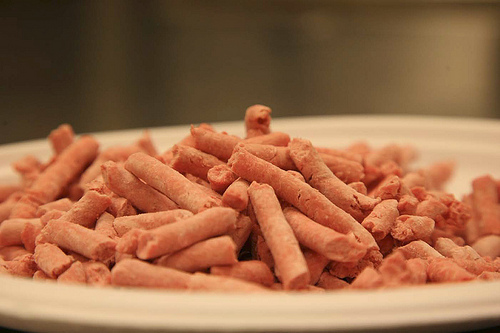
The substance has been added to most ground beef for at least a decade but has come under fire this year since a news story detailed how it’s made. The fat is melted out of fatty animal scraps, and what’s remaining, including connective tissue, is pressed together and mixed into ground beef to make it cheaper and leaner.

Beef producers not forthcoming about ‘pink slime.’ In southwest Ohio anyway, I put a stop to that.

Lean, finely-textured beef, AKA pink slime. Creative Commons-licensed photo courtesy of Flickr user pennstatelive.

Journalism, if anything, is reading documents carefully. Especially when they come from corporations with big public relations budgets.

With this story — whose fallout I’ll probably continue to report in the coming weeks — I throw a wrench in what, at best, were corporate oversights with favorable consequences. At worst, they were calculated plans to deceive school programs that feed kids. Often the poorest kids.

Chicago Tribune reporters had uncovered the same situation in that city. But I had no idea about it until my report was done.

I’ll paste the first few graphs here, but I’d appreciate it if you read the story on the paper’s site, and even commented on Facebook if you have the time.

-Brandon

Schools feel misled about ‘pink slime’

News-Sun investigation prompts more scrutiny about beef schools buy

By Brandon Smith-Hebson

For weeks, local school districts told the public they don’t serve food containing the controversial beef product known as “pink slime.”

Turns out they probably do.

A Springfield News-Sun investigation revealed that districts and food vendors may have been inadvertently misleading the public. Three key beef suppliers to schools acknowledge using what detractors call pink slime in some of their products.

After asking more questions of the suppliers, a few school districts have changed their menus.

“They were telling the truth, but not the whole truth and nothing but the truth, is how I feel,” said Chris Ashley, director of Springfield City Schools’ meals program.

For the privilege of saving 6 cents a month, please pay $50

The City of Springfield says no one has applied to its new program to award a kind of tax break to those who minimize runoff from their properties. (The city’s often forced to process said runoff as sewage, an expensive proposition.)

Like very few others, I read the credit manual from cover to cover. It has people paying a $50 application fee for the chance to save an average of 6 cents a month. Even the guy in charge of the program said he understood why people weren’t applying. My story posted the question: why write a manual at all?

I can understand trying to “protect the revenue stream,” as the city says, but a lot of our readers thought this went above and beyond.

Bed bugs on the rise

According to county health data, one out of every 42 homes in Springfield called for help about bedbugs last year.

My story corroborates the increase with several sources and describes the real health threat — trying to treat them yourself without knowing what you’re doing. An inset box (that only appeared in print) gives some tips about how to spot ’em and what to do about it.