Two months and four hundred handwritten pages later…

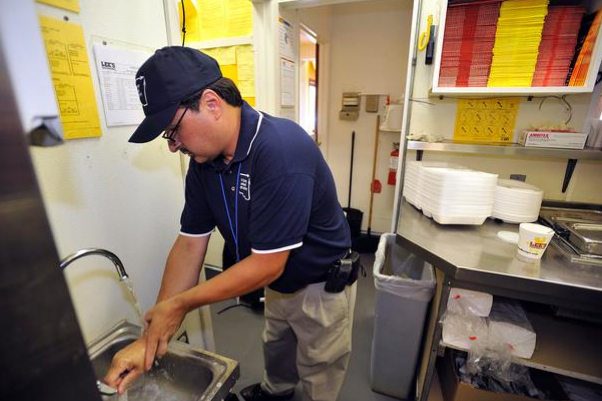
Larry Shaffer, health inspector for the Clark County Combined health district, washes his hands before starting his inspection at Lee’s Famous Recipe Chicken. Clark County health inspections reveal some dire situations in the area’s commercial kitchens. Photo by Bill Lackey, used courtesy of the Springfield News-Sun.

Here’s my front-page story today on restaurant inspections. It was quite the ordeal. I got to draw on my previous experiences in the kitchen, and I had to keep editors abreast of the project throughout its two months of reporting.

I was asked to write a short piece on how it all came together, so I’ve pasted that after the jump.

Continue reading

New Carlisle landfill on ODH’s watch list

An employee speaks with the owner of Scarff’s Wholesale Nursery. Scarff’s drilled four wells in an attempt to avoid pollution seeping from a nearby landfill, and still had to be connected to city water. Photo by Marshall Gorby, courtesy of the Springfield News-Sun

Big splash on the front of today’s News-Sun: my story on a landfill just south of New Carlisle. People may be drinking carcinogenic water and not know it, because years into EPA’s Superfund process, no nearby wells have been tested.

An obscure Ohio Department of Health tipped us off to the story. They’re concerned.

The aquifer there is slow-moving — imagine water moving through a jar of gravel and sand — but it serves something like two million people. Water activists around here get pretty fired up about it.

Vinyl chloride is the chemical they’re most worried about. It’s a potent carcinogen.

A setback for the truck-maker in Navistar v. EPA

International trucks on display at a show in China, April 2011. Creative Commons-licensed photo by Flickr user SimonQ.

In a followup to my story last month, I just wrote about a development in Navistar v. EPA, the lawsuit that the truck company with the local manufacturing arm filed against the environment agency.

How this setback for Navistar will affect the overall suit, if at all, I’m not sure. I don’t have a cadre of legal experts yet in my contacts. I could have lifted a quote from Law360, but a full subscription — the only option available — is out of reach for our newsroom.

Yet, I used the service to get the initial information. Without it, I wouldn’t have known to do the story.

This is I think the third time I’ve used Law360’s free case law updates (narrowed to the environment subject area) to find a story. A couple months back, my editors and I tried to subscribe, so that I could read full articles. It’s just not worth it. I think they said $1,200 a month. With their free daily updates, I can just read the first few graphs and get the case number for PACER, circumventing the news company. Obviously the most valuable thing is the timely news update itself, and they’ve giving it away.

My editors would love to pay Law360 on a per-article basis, or at least on a single-user basis. No dice. The company should really consider a less-costly option for smaller-market news reporters.

Mosquito story has legs!

A U.S. Army officer separates male and female mosquitoes to test for the presence of disease in the South Pacific. Creative Commons-licensed photo from the Flickr account of the U.S. Army’s Korea outpost.

Hey everyone. This is the story with the greatest traction I’ve had so far in my career: At least five newspapers and at least 10 TV stations across the country.

Originally I was just supposed to take something our sister paper in Dayton wrote and add in local comments. I took one more day, dug a little deeper, and got the following story: Ohio only tests mosquitoes in 20 (now 21) of its 88 counties.

It appeared in print at the top of the front of our local section, likely because I didn’t have the time to sell the story to editors for what it was. Certainly no one here realized just how interested the rest of the news industry would be. (P.S. – Writing the headline for the jumped section, copy editors did improper math.)

To summarize, the state provides free test pools, lab analysis and shipping to and from that lab… but less than one-fourth of Ohio’s counties have any testing going on for mosquito-borne viruses, which are drastically on the rise this year. Local health departments cite the cost of labor for placing and retrieving these test pools.

Yes, most of the state’s population is covered, because most big cities have testing. But huge swaths of the state, geographically, forgo the process. The state department of health admitted this could mean outbreaks we don’t know about.

A quick Google search seems to indicate that in addition to my paper, the following newspapers picked it up from the AP wire:

The Columbus Dispatch, The San Francisco Examiner, Houston Chronicle, Huntington (W.V.) Herald-Dispatch.

In addition to our TV station and radio station, the following TV networks aired versions of it over the weekend:

NBC4 Columbus, WSYX Columbus, WTTE Columbus, FOX19 Cincinnati, WTOL Toledo, WTVG Toledo, WFMJ Youngstown, WHLT Hattiesburg, MS, WCNT Greenville, NC

…plus lots of other smaller Ohio outlets (Coshocton, Newark) and lots of other subsidiary radio stations of those TV stations or newspapers.
Pill Mill story

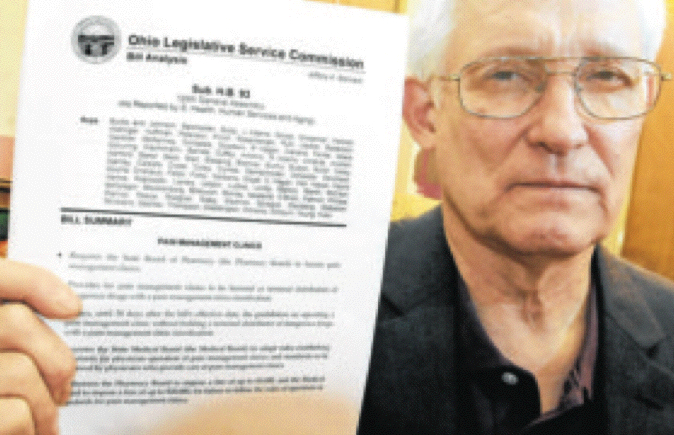
Springfield Psychologist Owen Ward says he now spends most of his time trying to find doctors who will prescribe his patients pain medication for their physical injuries. Doctors say the former House Bill 93, a copy of which Ward holds, has had a chilling effect on the prescription of pain medication. Photo by Marshall Gorby, courtesy of the Springfield News-Sun.

A weeks-long investigation reveals that some people are getting short shrift in the crackdown on narcotics: those who actually need them. Here’s the main story, and here’s the sidebar, which focuses on a couple specific patients.

The Columbus Dispatch scooped us on the story after I had worked on it at least 4 weeks on-and-off. So I took another two weeks and reported a stunning fact — that some doctors think the medical board misled their ranks shortly after the law was passed.

Full story on Navistar v. EPA

While it made the lead story on the front of the local page today, my piece on Navistar suing the EPA got cut because of length. I’m posting the whole story here.

Navistar’s new engines recirculate a larger amount of exhaust back into the cylinders than has been done before, which cools combustion, limiting the formation of nitrogen oxides. Its competitors have chosen to treat nitrogen oxides after the fact.
By Brandon Smith-Hebson
Staff Writer

In a lawsuit filed July 5, Navistar accused EPA director Lisa Jackson of not doing her duty to uphold the Clean Air Act, and her agency of not doing its part to protect public health.

If Navistar’s claims hold true, trucks from model 2010 and beyond would not have to meet Clean Air Act standards when it comes to nitrogen oxides — chemicals best known to cause the brown haze around smoggy cities.

Navistar, the large local employer and national manufacturer of large trucks, hasn’t suddenly turned into an environmental crusader — in this case, its profits seem to be tied to the health of the ecosystem.

Continue reading