Writing for interaction

Spotted a story yesterday about the rise of (and grand question about) the cupcake boutique on the New York Times site, and I had to check it out.

I’m sharing it with you not just because cupcakes generate more saliva than I have fluid in my body, but because there’s a really interesting paragraph that reads like a blog. Even though the story appears in the Small Business section (at least that’s their header):

“Cupcake stores are taking the place of ice cream stores,” said Adam Borden, whose Baltimore-based venture capital firm, Bradmer Foods, specializes in food-focused enterprises. “Cupcakes aren’t seasonal like ice cream, and they appeal to people who want the authentic experience. They have an allure based on nostalgia.”

All of which suggests a couple of questions: How many cupcakes do you have to sell to pay the rent? And are cupcakes a viable business? These are still very early days in the Great Cupcake Rush, but the answers appear to be, respectively, a lot and maybe. (What do you think? Click HERE to leave a comment.)

I like it. It recognizes that readers expect to have interactivity built into the text they read, and they are becoming more and more comfortable with writers acknowledging that interactivity, rather than what I call “playing dumb.” That’s where the story is written as if for a printed page, but oops, there’s something we could link to there. Let’s slap some HTML underneath to appease the surfers. Well you didn’t appease me. You just made me wonder, for a split second, why this word was underlined and in a different color.

Even though I’m the first generation to literally grow up with the Internet, I still trip up with that. So I don’t think it’s a generational thing; people will continue tripping up over writers’ “playing dumb.” Thus, they shouldn’t be told they have to by silly, out-of-touch editors. Nice job New York Times Small Business section.

But wait, isn’t there someone who’d been writing casually and “to” the interactivity for a while now? Yes. Political reporters Mick Dumke and Ben Joravsky, at the Chicago Reader.

Joravsky’s column last week was mostly journalism, but written in a casual tone. People don’t read it for his opinion, they read it for the journalism. And for the directions on how to see where their money is going, if not what it’s being spent on.

Cookoff: roommate

Then-Sous Chef (now Chef de Cuisine) Jon Bignelli of D-50, preparing Squab with butternut noodles, cream soda and carob. (Creative Commons photo from the Flickr account of diacritical)

Here’s the most interesting thing to happen to me in a long time: a winner of Bravo’s Top Chef recommends I have potential roommates cook for me, so I can find someone who loves food as much as I do.

What a rockin’ idea!

The Chef is Stephanie Izard (here’s her blog), and via a Twitter conversation, I lamented that I’m having trouble finding someone who likes food as much as me. She suggested I make them cook for me. My translation: a full-blown cookoff.

But what’s a cookoff if no one’s participating? To that end, I’m spreading the word among Chicago’s media (and social media) that I have a Gold Coast apartment ready to share with the best cook I can find to room with. I’m also trying to spread the word among students of the Culinary and Hospitality Institute of Chicago—AKA CHIC.

I’ll keep you updated on my marketing progress, and after I return to Chicago from a Thanksgiving holiday in Ohio, I’ll shoot some pictures of the apartment for this continually-evolving post, to which I’ll refer candidates.

I figure the cookoff will take place mid-December, with a move-in date as soon after as possible. (Maybe I’ll have to wait until Jan. 1, I dunno.)

Links

I kept writing but haven’t posted in a while, so I just wanted to fling a link your way before I hopped a bus to Columbus, Ohio to see the fam. (Look for more posts to come soon, however.)

The Yes Men, a group of nationally-known pranksters, did some protesting of the Fisk power plant here in Chicago while they were here for a premiere of their new movie. The Yes Men’s most recent was here: http://www.democracynow.org/2009/10/20/yes_men_pull_off_prank_claiming

Jeffrey Hollender, you rock my socks

Hollender

Jeffrey Hollender, CEO of Seventh Generation (Creative Commons photo from the Flickr account of dreamymo)

Note: This post is continued from Thursday’s post. I suggest you start there.

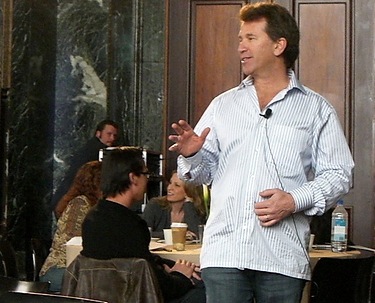
Hollender attended a conference by Business for Social Responsibility and blatantly asked the question, “Will this conference make business more responsible?

It’s a good question to ask since BSR is, according to Hollender, the largest and most well-known organization promoting socially responsible business practices. Hollender’s answer in so many words: “No.”

I sense the same ineffectiveness with conferences such as GreenTown. My college, Columbia College Chicago, hosted it recently, and I covered Robert F. Kennedy Jr.’s speech there, as well as a panel on waste diversion. But did it actually do anything to help the planet? Will the city officials who attended actually take anything away from it? Yet to be known. (If it’s hard to find the tangible results of something as big as this, hasn’t it failed anyway?)

How about the one-year get-together of players in the Chicago Climate Action Plan—was this any more than a back rub for those involved? I doubt it.

So thanks, Mr. Hollender, for saying what needs to be said. I hope I can always be that way myself.

Link of the day

Is the familiar old HTTP on the way out?

Hyper Text Transfer Protocol, the mode of communication that has propelled the “information age” to infect every sector of life in developed nations, has served us well. But leave it to Google to propose its replacement.

No telling whether the company’s idea will actually take hold; these kinds of things are more of a public project than a private endeavor.