BrandonSmith.com

Is now mine.

For my entire life (okay, the twelve years the internet has been mainstream) I didn’t have any hope I’d actually own my name’s domain.

There’s a pro football player with the same name, as well as several other quasi-famous people. I thought they’d be all over the bidding wars, life savings in hand.

As it turns out, no bidding war required. I saw its availability a few days ago and could hardly believe my eyes. It’s worth at least $1,000, probably much more. I know this because a month ago, the company that owns brandonsmith.net offered me that domain for $600, and .coms are worth much more. I paid $97 for mine. It’ll be indispensable to my career from now on.

In a few years I think I’ll buy up a few domains for potential kids’ names. It’s only $10 a year to maintain ownership of each one, and I suspect it could help them quite a bit in life.

This purchase also motivates a redesign of my little corner of the Interwebs. I’ll probably use Columbia’s web team, but I won’t use their hosting since there are lots of restrictions. Luckily a friend of mine has offered me free hosting since he has unlimited space and my material is pretty small, all things considered.

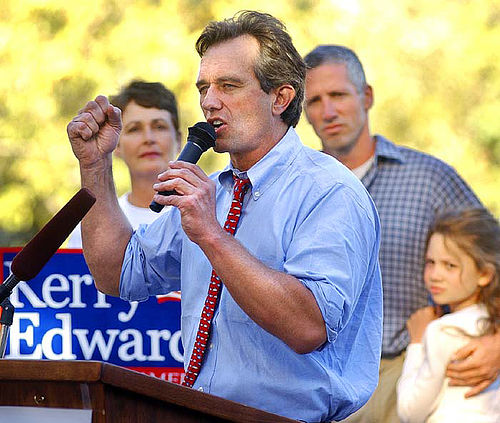
Bobby Kennedy, Jr. liveblog transcript

Flickr CC photo by Erik R. Bishoff

Flickr CC photo by Erik R. Bishoff

Robert F. Kennedy Jr. spoke at my school this morning, at an environmental conference. Had to post a stock photo because I don’t yet have a camera…

I ate breakfast with him before his speech, basically a preview of the kinds of things he was gonna say, then live-blogged the speech itself on twitter.com/greenletters. The transcript of the liveblog is below for your consumption. I left out the analysis. If I end up doing that for a class, I’ll listen to a recording of the speech. (I’ll let you see that, too, if I do it.)

Gonna try to liveblog Bobby Kennedy Jr.’s speech at GreenTown Chicago. That is, until my laptop battery runs out.

RFK Jr.: Protect the commonwealth, the shared properties like air & water. The private sector takes them over when they pollute them.

RFK Jr.: “Environmental impact is defecit spending. it’s a way of loading costs onto our children’s future.”

RFK Jr.: Conversely, environmentally friendly stuff is not throwing money away, it’s an investment. It’s money in the bank.

#greentown RFK Jr.: We are borrowing a billion dollars a day from nations that largely don’t share our values…

#greentown RFK Jr.: …to buy a billion dollars of oil a day from nations that largely don’t share our values.

#greentown RFK Jr: Coal isn’t the cheapest source of energy: The U.S. subsidizes the industry $1 tril. annually; that’s not accounted for.

#greentown RFK Jr.: The reason we can’t have high speed rail in this country is because the coal gondolas have warped all the rail tracks.

#greentown RFK Jr.: “Whenever you see the destruction of the environment, you always see the subversion of democracy.” (“corruption.”)

#greentown RFK Jr.: As Sweden, Iceland and Brazil decarbonize, they give us evidence of the economic successes that can be had doing it.

#greentown RFK Jr.: There’s enough wind in Montana and S.D. to supply all the U.S.’ energy, even if every American owned an electric car.

#greentown RFK Jr.: We can do long-haul transmission of electricity. We need to do it. The problem? Stupid, “irrational” rules.

#greentown RFK Jr.: A CEO must choose between his loyalty to shareholders and his loyalty to humanity. That’s an unfair decision. Change it.

#greentown RFK Jr: Price of bits and bytes has dropped to about 0. That’s what’s gonna happen to electrons as soon as we build a nat’l grid.

#greentown RFK Jr: How do you pay back $1.4 tril? In 2 years, by saving the $700 billion a year we’re sending to places like Saudi Arabia.

#greentown RFK Jr: Solar-thermal: Roughly $3 billion a gigawatt, same as a coal plant. But free energy for the life of the plant.

#greentown RFK Jr’s green venture capital firm: we’re gonna take trillions away from carbon-energy in 10 yrs. “Destroy” em at their own game

#greentown RFK Jr.: We’re funding both sides of the war against terror… How to stop? Stop buying gas from the guys who drop bombs on us.

#greentown RFK Jr.: “Polluters make themselves rich by making everyone else poor. … You show me a polluter, i’ll show you a subsidy.”
Summer 2008 work

Here are four clips published summer 2008 in the Wilmington (Ohio) News Journal. For more representative samples of my work, see the this page.

t-frontier-day-story2

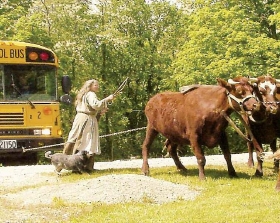
May 21, 2008 — A feature describing how kids learn about life on the American frontier. Oxen had to pull their bus from the mud.

t-housing-market-story_page_12

June 21, 2008 — At first the Wilmington housing market wasn’t affected by DHL’s announcement. Foreclosures were a bigger problem that had been growing for years. (I did a housing market story before it was cool to do a housing market story.)

t-vets-group-story_page_22

May 24, 2008 — As part of a Memorial Day tribute section to veterans, I met with a local group of Iraq and Afghanistan veterans who gave up on the VA and started counseling each other.

t-mccain-story_page_12

July 11, 2008 — I reported the first national attention the Wilmington area received in its ongoing plight with DHL. Wilmington’s story went on to be featured on 60 Minutes.

Light green, dark green, in between? Off the deep end?

Flickr CC photo from nickwheeleroz

Flickr CC photo from nickwheeleroz

Someone recently asked me this question: Do you think we should change our lifestyles to be more environmentally friendly? Or are you more dark green, like we should drop everything we’re doing and start completely over, radically changing our entire lives? Or are neither of those solutions?

The questioner is a smart cookie, and loves the earth as much as I do. It wasn’t really meant to be a trick question, but it kinda turned out like one. I answered something like this:

“Personal changes will only take the rescue of our planet so far. I guess you would call me very very dark green, in the sense that neither of those are solutions. Our societies need to uproot the entire culture, specifically corporate and governmental, in order to revamp them for a healthier earth.”

(Don’t you love how articulate you can be when you’re recapping your own words later in writing?) I went on:

“I’m the kind of guy who thinks true revolution is in order. And I mean revolution on the scale of battling the greatest injustices of all time: Czarist Russia, Nazi Germany, Antebellum America. I’m not comparing the evils of those regimes with the evils of destroying the environment, because they’re very different. This current evil is much more subtle and complex. But destroying it will take just as much political, cooperative will power as destroying those examples I gave.

“Lots more otherwise-mild-mannered people feel the same way. The innocent nature mag ‘Orion’ has recently ignited generations of thrift-store green kids and sweater- and birkenstock-wearing nature writers and philosophers. I’m thinking ‘V for Vendetta.’

“Did you know something like 20 or 25 percent of all water and electricity are used by people individually? The rest is used in the corporate, government and agricultural worlds. Most of it could be quelled if it weren’t for mismanagement. But no one’s standing on the street corner or making movies about the gross overuse in those sectors. It’s gonna take the toppling of a way of life to put us in equilibrium with nature.

“Of course I don’t see us ‘dancing naked around campfires’ again. We’ll find ways to maintain a goodly amount of our technological and social advances while not screwing up nature. But some of it has to go, certainly. And some of it we should be thankful to lose.”

The questioner was of the same persuasion. Except he had formulated all this himself, without the help of Orion magazine. I told you he’s smarterer than me.

Check out these three articles, rightly in the group of most-read articles on Orion’s website. They’re the paragon of so-called environmental writing at this point, as far as I’m concerned.

World at Gunpoint, or, What’s Wrong with the Simplicity Movement

Forget Shorter Showers – Why Personal Change Does Not Equal Political Change

The Gospel of Consumption – And the Better Future We Left Behind