Superfund multimedia extravaganza!

Or at least, that’s what I call my textual-visual-auditory, multi-platform news story about the nearest Superfund site to me, Lammers Barrel Factory.

super-fun

The old (and toxic) "Lammers Barrel Factory" is next to a residential subdivision.

In case you didn’t get to see the TV news package a couple weeks ago, here it is again. (If the video’s still squished, pardon me. The fix is on the way.)

But now I have more for you. Much, much more.

I’ve written a web-magazine format story with all the juicy details I haven’t included elsewhere before.

Here’s a really cool feature: a video of the actual 1969 fire that released all the pollution. It was shot by a Beavercreek fireman with a Super 8 camera. Since the video itself didn’t have sound, music was inserted into the background when the footage was digitized a few years ago. Kip Smith, currently Battalion Chief with the Beavercreek Fire Department, was kind enough to narrate the 15-minute long video. (He was at the fire, too.)

Last but not least, you can view a slideshow of pictures I took about a month ago at the site itself. I know you’ll be curious about this place, so spare yourself from getting the cancer-causing chemicals on your shoes and look at the pictures I took.

CU/Green on water use and landscaping

CU/Green: Things Cedarville University should consider doing in order to be good stewards of the Earth.

The world's biggest desalinaation plant. The diameter of those membrane tubes is about the diameter of your hand. Flickr photo from Sasyl. CC.

The world's biggest desalinaation plant. The diameter of those membrane tubes is about the diameter of your hand. Flickr photo from Sasyl. CC.

Water supply quality

  • Commission the engineering departments to do a study on the Village water quality. I hear some professors are wary of the water around here. The state EPA guidelines do allow for variation in quality.

Water filtration effluent control

  • This site allows you to find those entities who have permits to discharge waste into waterways (although not necessarily treated human waste). This page details Cedarville University’s violations of its discharge permit. In summary, CU filters its water through sand filters before it gives it to us to drink. Periodically it flushes those filters and dumps the stuff that comes out of them (usually concentrated minerals like iron) into waterways. Well, CU violated acceptable levels of contaminant (like iron) discharge on these dates: June 30, 2008; Jul 31, 2008; Nov. 30, 07; Dec. 31, 07; Jul 31, 07; and a different type of violation on these dates: Feb 29, 08; May 31, 07; Apr 30, 07. The EPA contact who handles CU’s account said that it wasn’t human error and that we’ve fixed the problem every time. But we need to invest in better mechanical apparatus so violations don’t happen in the future.

Water conservation

  • replace all urinals with waterless urinals, which, opposed to common sense, are more sanitary than water urinals. They’re obviously less costly to operate. I’ve heard in several places that the reason everyone still uses water urinals is because plumber’s unions are very powerful and it takes half the work to install a waterless urinal.
  • install low-flow shower heads. These use about 1/3 the water of normal shower heads and aren’t really a sacrifice.
  • We may not want to try to tackle this right now, but greywater reclamation is always available. We could use it on our landscaping, but not a University farm, since the chemical from soaps, etc. aren’t good for food.

Landscaping and decoration

  • stop using lawn fertilizers and pesticides unless they’re very green-friendly, and then only sparingly. Allison McClain, President of the new environmental organization on campus, says she knows some students in the sciences who’re working on lawn-care substances that don’t wreak other habitats — such as Cedar Lake and its algae problem.
  • For that matter, commission the engineering department to do a study on Cedar lake — I’ve heard it’s not a fully-functioning habitat with natural equilibrium. Let’s make sure it’s as healthy for all native organisms as it can be.
  • We might rethink the types of grasses grown on the campus. Can we plant any that don’t require as much mowing or fertilizer or water?
  • reconsider the nature of the indoor plant contract. Maybe replace some of the more tropical plants that use lots of water and/or fertilizer with more flora native to this region. (Also for a plant tip, see the section on indoor air quality.)
  • revamp the tree-planting policy to reflect another mindset, one more like “why shouldn’t we plant a tree here?”

Christians leading masses to Earth-love

Now, I certainly don’t mean Earth-worship. Just Earth-love, good for you and good for me. That’s what this blog is about.

Hmm… I can’t think of a way to frame this link, I just have to show it to you: Activist Fail. This is when you know you’ve gone too far. …Then again, I dunno. Do you feel sad that a 250 year old organism, whose biomass was 1,500 times your own, was killed to supply you with extra-soft toilet paper or tissues? I do. That’s why when I can get away with it, I sneak in some of the recycled stuff into our grocery cart.

Davey Woods near Urbana, Ohio. It's the nearest old-growth forest to Cedarville/Dayton/Springfield. Photo from the Ohio Dept. of Natural Resources

Davey Woods near Urbana, Ohio. It's the nearest old-growth forest to Cedarville/Dayton/Springfield. Photo from the Ohio Dept. of Natural Resources

(Did you know: a general rule of thumb is, the softer the toilet paper or facial tissue, the more virgin and/or “old-growth” timber was used to produce it?)

Who knows, maybe those people in the video have gone too far, essentially lowering God (if they think there is one) below nature. But that wasn’t necessarily apparent in the video.

Now that some of my Cedarville audience thinks I’m crazy, I’ll tell them why loving the Earth is not. This article, from the journal Perspectives on Science and Christian Faith, features a condensed version of the Christian philosophical justification for caring for the environment. (And the author, Fred Van Dyke, knows his stuff. Look at his bio on the first page.) The piece is 15 pages of text, but you only really need to read the first 3-4 for the good stuff. As an added bonus, the article describes that Christians are actually on the forefront of the environmental movement.

Read it? Good. It’s time to put our money where our mouth is and live this stuff out. The respect of the entire scientific and intellectual worlds is at stake.

CU/Green on building upkeep, construction

CU/Green: Things Cedarville University should consider doing in order to be good stewards of the Earth.

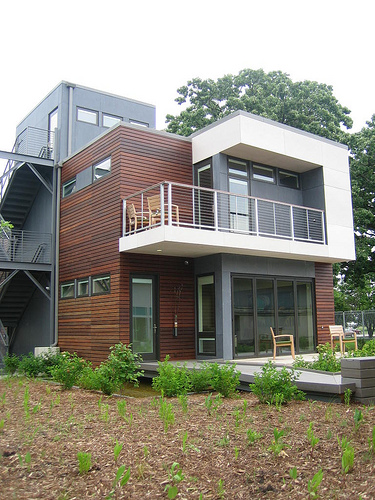
A prefab modular home. Flickr photo from Heather Lucille. CC.

A prefab modular home. Flickr photo from Heather Lucille. CC.

Regular building maintenance

  • Get ideas from LEED and other certification standards when purchasing new parts for buildings. (Read on for alternatives to LEED)
  • Commission the engineering department to do a study on “green roofs.” Can our roof strctures support a few inches of soil and a bunch of plant life? It does wonders for water filtration and insulation.
  • Mandate that all new paints be free of volatile organic compounds (VOC’s). That stuff is nasty — with high enough exposure to the right VOC’s (particularly for the painters), it can give you cancer and make your liver stop working.

Heating/cooling/insulation

  • install geothermal heating and cooling systems. If they pay off in 15 years or less, they’re a good investment because they last much, much longer.
  • have a weatherization inventory taken of all existing buildings. Supposedly this cost and the cost of actual weatherization is recouped very soon, as it tends to produce savings of about 30 percent on annual heating/cooling bills thereafter. Maybe this could be done before geothermal wells are installed, since their number could be lessened.
  • Commission the engineering department to do a study: If we removed the tint from the windows on campus, how much more thermal intake would the buildings have in winter? What could we do to increase thermal mass that could be heated by the sun during the day and keep buildings warm at night?

Future building projects

  • make a very serious effort on the next building project to engineer a building that is, if not LEED-certified, at least comes with lots of features of those that are. Now, you can be green without having LEED (as our newest building, to a certain extent, testifies to). But you can also have LEED while not truly doing well for the environment, as this article will tell you. So beware! (If you want additional resources on alternatives to LEED, the article there links to a few good ones.)

The College Sustainability Report Card

As you have been reading the past few days, I’ve been making suggestions specific to our school. They’ve stemmed merely from my eco-research over the years intersecting with life at this school. But today I found a rather objective treatment of college eco-valuation.

The College Sustainability Report Card rates the 300 schools in the U.S. and Canada with the largest endowments, so Cedarville is not included.

But I’ll be looking at their criteria to get ideas for our up-and-coming environmental organization. I’m the VP of this group, and we’re hoping to hash everything out over the summer to ensure a functioning organization this fall. The president, Allison McClain, is doing marine biology with the Smithsonian Institution in Maryland this summer. I haven’t figured out what I’ll be doing (I know, it’s a week away, right?) but whatever it is, I’ll be writing as usual. Maybe I’ll work as a farmhand on an organic vegetable farm.

I think that’s the most interesting thing about this new environmental org — we pull in people from all disciplines. Out of our current group of officers, we have at least the following areas of study represented, maybe more: literature, biological sciences, communication/journalism, philosophy, law, international affairs, business, environmental studies.

I’m holding out for a studio art gal or a piano performance guy.

Stay tuned for daily “CU/Green” updates! I plan to present the ideas to our University President when they’re all finished. Why do they appear daily rather than all at once? Because after a couple weeks of you reading this site regularly, it becomes a habit. Muahaha! No seriously, I study Communication, and I know for a fact that people tend not to read blog posts longer than a few hundred words. So I’m out at 287.

CU/Green on clothing and consumer goods

CU/Green: Things Cedarville University should consider doing in order to be good stewards of the Earth.

Flickr photo from stevevance. CC.

Flickr photo from stevevance. CC.

Clothing

  • Encourage the CU community to buy second-hand. Not only will we reduce new-item consumption and decrease clothing in landfills, but we will decrease the demand for sweatshop labor and possibly stop caring as much about the latest “fashions.” Yes, we have to look good for employers (so buy one Brooks Brothers or Express suit for interviews and career day) but we shouldn’t be “about” our looks as much as we are currently.
  • Disallow clothes to be washed in warm or hot water, as cold water is proven to clean just as well as cold water and requires no heating energy.

Consumer goods

  • Encourage the CU community to reduce its consumption of material things. The “do I really need this?” philosophy epitomizes this, but we don’t all have to take on the 100 thing challenge. We should try maintaining libraries of things like tools and specialty electronics. If you don’t know what I’m talking about (“Product service systems”), Wikipedia doesn’t do as well as this Treehugger article at explaining it.
  • Other simple guidelines could include “don’t buy it new if you can fix the old one — but better yet, maintain the one you have.”
  • Tell prospective students and incoming freshmen that since we supply computers for everyone (and public ones in academic buildings), there really isn’t a need for a laptop during the stay here. (Tell them we didn’t used to suggest this before, so that’s why many older students have them.) What about taking notes in class? they might ask. Even though Blackboard use may naturally (or by edict) increase in the coming years, paper notes are the greenest option since laptops purchased as freshmen will almost be out-of-date by graduation, shortly to become deadly e-waste. (E-waste often harms disadvantaged people, according to this report by 60 Minutes.) If incoming students have the money for a laptop, encourage them to stash it away until they graduate, when they can get one that’s up-to-date. Maybe even offer them an interest-bearing account to stuff it in, so they’ll get more bang from their buck from that as well as from Moore’s Law.