Busy, busy, busy

One reason I haven’t updated this in a while is that I’ve been busy… looking for an apartment in Chicago (the city I’ll call home for at least two years to come), looking for a job in Chicago, visiting a friend who was recently diagnosed with Leukemia, and getting classes and financial aid squared away at Columbia College Chicago.

I’ll be in the journalism program called Reporting on Science, Health and the Environment, and I’ll have a minor in Magazine Writing and Editing. The science-writing program is headed by Jeff Lyon, a Pulitzer Prize winner. Also a really great guy.

The other reason I lag is that I haven’t been writing stories about very in-depth topics. And I don’t like showcasing daily grind work, as important as that is for news organizations. If you want evidence I’m reliable on a daily basis, talk to my editor.

I might, however, pass on one link, to a cold case murder story I helped cover one day. Who knows why my byline isn’t there. It’s all me. It had top-story placement the next morning.
Uncle Sam, here’s $38.8 billion. I want $9.6 billion of that back.

Tuesday’s paper headlined my story on two dentists indicted on tax fraud charges. (Here’s the PDF, but it doesn’t have all the content the web treatment does.) Sounds supremely boring, right?

That is, until you slog through a dull-as-nails 29-page indictment. Then you find juicy tidbits, such as the following details that federal prosecutors allege:

  • These men owed hundreds of thousands of dollars to the IRS
  • They tried at least twice to pay the IRS with fake money in the form of various documents (like securities)
  • Last year these fake payments totaled $38.8 billion. (Yes, that’s billion with a “B.” The next day friendly locals called our office to make sure we hadn’t made a colossal typo.) It wasn’t clear in the indictment why the dentists decided to make their “payments” so high, and I couldn’t get anything else out of the federal prosecutor’s office.
  • Shortly following the multi-billion-dollar “payments,” they asked for $9.6 billion in tax refunds.
  • Last year, while being investigated, the men wrote letters to the government claiming, among other things, they were not legally “taxpayers” or “people,” and asking for the definition of “IRS agent.”

Needless to say it made for a great headline and an interesting story if you don’t mind the hard news-format writing. We report, you decide where you think these men are coming from.

An interesting tidbit: someone on staff at our newspaper has had teeth worked on by the dentist with a Wilmington practice. How would you feel if you discovered this about your dentist?

Lastly, I had previously promised multimedia from the last DHL shift. I’ll put together a Soundslides slideshow when I have time, which should be early to mid next week.

DHL’s last sorting shift

Between 4 and 6 this morning, the DHL air park held its last shift of package-sorting in Wilmington, Ohio. It represents the conclusion of the largest single layoff in Ohio history. I covered it with two colleagues from the News Journal, as well as reporters from 60 Minutes, Dayton Daily News, and channels 7 and 9 out of Dayton and Cincinnati, respectively.

Our coverage is in breaking-news form right now, which doesn’t include my photos and video. But I’ll link to my coverage once it appears. For now, you can read the story I co-reported with my new Assistant Editor, Brandy Chandler. I wrote about the first two people, Lisa Kanzius and Terri Elan. Brandy wrote about Dave Sanderson and Kent Schilling.

I have to go, or else I’d post some photos. I’ll get to that soon.

Applied Sciences slideshow back online

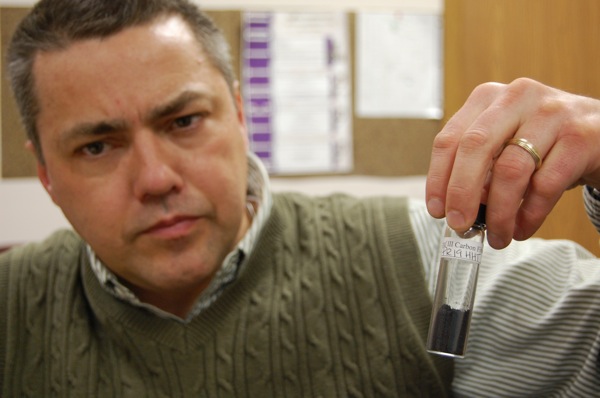
John McKay, Communications Director at Applied Sciences, holds a vial of carbon nanofibers, the key to making batteries more efficient.

John McKay, Communications Director at Applied Sciences, holds a vial of carbon nanofibers, the key to making batteries more efficient.

I was able to work out the bugs in the Flash embed code, so you can now, once again, view my slideshow about Applied Sciences. This company, near distressed Dayton, Ohio, invented the tech to double the capacity of any lithium-ion battery. Here’s the link.